EX Era Pokemon TCG — Complete Era Guide
| Era | EX era (2003-2007) |
|---|---|
| Year range | 2003-2007 |
| Sets in era | 16 |
| Total cards | 1,722 |
| Mechanics introduced | Pokémon-ex, Gold Star, Delta Species |
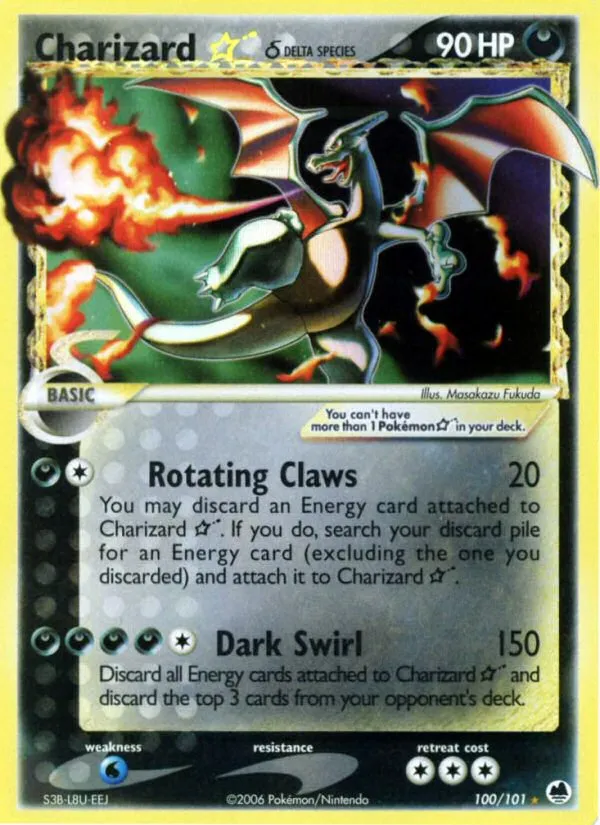
| Headline chase | Charizard ex (FRLG), Mew Gold Star (Holon Phantoms), Charizard δ Gold Star (Dragon Frontiers), Rayquaza ex (Deoxys) |
| Top card | Charizard ★ δ (Dragon Frontiers) — $4000.00 |
| Combined market value | ~$88331 |
The four-year run after Nintendo took back the license, defined by Pokémon-ex (full-art ultra-rares with knockout bonus rules) and Gold Star Pokémon (alternate shiny artwork at roughly 1-in-30 packs). 16 sets, hundreds of ex cards, and Delta Species mechanics that retyped Pokémon (Fire Mewtwo, Lightning Gyarados, Metal Charizard).
The EX Era spans 16 booster sets across 2003-2007, with 1,722 unique cards and a combined TCGPlayer market value of approximately $88331. Chase cards include Charizard ex (FRLG), Mew Gold Star (Holon Phantoms), Charizard δ Gold Star (Dragon Frontiers), Rayquaza ex (Deoxys).
Every set in the EX Era
- Ruby & Sapphire (2003) — 109 cards · most valuable · EV calculator
- Sandstorm (2003) — 100 cards · most valuable · EV calculator
- Dragon (2003) — 100 cards · most valuable · EV calculator
- Team Magma vs Team Aqua (2004) — 97 cards · most valuable · EV calculator
- Hidden Legends (2004) — 102 cards · most valuable · EV calculator
- FireRed & LeafGreen (2004) — 116 cards · most valuable · EV calculator
- Team Rocket Returns (2004) — 111 cards · most valuable · EV calculator
- Deoxys (2005) — 108 cards · most valuable · EV calculator
- Emerald (2005) — 107 cards · most valuable · EV calculator
- Unseen Forces (2005) — 145 cards · most valuable · EV calculator
- Delta Species (2005) — 114 cards · most valuable · EV calculator
- Legend Maker (2006) — 93 cards · most valuable · EV calculator
- Holon Phantoms (2006) — 111 cards · most valuable · EV calculator
- Crystal Guardians (2006) — 100 cards · most valuable · EV calculator
- Dragon Frontiers (2006) — 101 cards · most valuable · EV calculator
- Power Keepers (2007) — 108 cards · most valuable · EV calculator
Top 10 most valuable EX Era cards
Across all 16 sets in this era, ranked by current TCGPlayer market price. Click for pull odds and the set context:
- #1. Charizard ★ δ — Dragon Frontiers #100 — $4000.00
- #2. Rayquaza ★ — Deoxys #107 — $2500.99
- #3. Lugia ex — Unseen Forces #105 — $2500.00
- #4. Latias ★ — Deoxys #105 — $2300.00
- #5. Treecko ★ — Team Rocket Returns #109 — $2250.00
- #6. Mew ★ δ — Dragon Frontiers #101 — $2200.00
- #7. Torchic ★ — Team Rocket Returns #108 — $1969.69
- #8. Pikachu ★ — Holon Phantoms #104 — $1899.99
- #9. Jolteon ★ — Power Keepers #101 — $1701.21
- #10. Raikou ★ — Unseen Forces #114 — $1600.00
Open EX Era packs free on PackRip
Every set above is playable for free on PackRip with the same per-rarity pull rates the real product had. Pick a set from the list and click "open" — no signup, no install, mobile-friendly. Track your virtual collection across the entire era and compare which sets gave you the best chase pulls.
Why the EX Era matters in TCG history
Rarity evolution within the EX Era
The EX Era did not have a single static rarity ladder — each new set within the era added or refined the chase tiers. EX era stacked three chase tiers on top of the Rare Holo: Pokémon-ex (full-art ultra-rares, ~1-in-12 packs), Gold Star Pokémon (~1-in-30 packs), and Holon-era Delta Species (retyped Pokémon, full-frame art). Most EX-era sets ran 2-4 Gold Stars per release; Holon Phantoms doubled down with both ex and Gold Star chases in the same pool. By Dragon Frontiers (the EX-era closer) the chase tier had narrowed back to a single Charizard Gold Star, which is now the most-traded EX-era card outside of Mew Gold Star (Holon Phantoms).
Market context for the EX Era
How PackRip approximates this era
Every EX Era set in PackRip's catalog runs on one shared per-rarity rate table, defined as constants in the simulator's pack generator and stated on each set's pull-rate page. Those rates are PackRip's own model of how an era's rare slot behaves — they are not measurements of the real print run, and no official Pokemon TCG pull rates have ever been published. The catalog itself comes from the Pokemon TCG API plus per-card hand-curation for the chase tiers the API does not label cleanly (Crystal, Shining, Gold Star, Lv.X, Prime, LEGEND in particular). All EX Era cards are usable in PackRip's collection, dust crafting and quest systems exactly as if you had pulled the real card, and the entire catalog is free to rip indefinitely — there is no premium currency and no paywall.
Recommended path for collecting the EX Era
A practical path to a complete EX Era binder combines two steps. First, use PackRip's free simulator to rip the entire era — both for the experience and to see which sets have the deepest chase pools. Second, plan a targeted singles purchase for the specific binder holes that survive: typically the chase tier (Charizard ex (FRLG), Mew Gold Star (Holon Phantoms), Charizard δ Gold Star (Dragon Frontiers)) plus a handful of sentimental favourites per set. Chasing a specific card out of random sealed product is the expensive way to do it — that is exactly the variance the simulator lets you feel for free.
Collecting the EX Era today
Building a complete EX Era binder in real-world cards is a meaningfully harder lift than collecting a modern set. The 16 sets in this era are out of print, which means the singles market is the only path — sealed product trades at multi-x the original retail and pulling a complete binder from sealed is not a financially rational option. The chase cards in particular (Charizard ex (FRLG) and similar) typically trade for 10-100× the average common from the same set. PackRip exists in part to remove that financial gate from the experience: you can rip the simulator for as many EX Era packs as you like, collect every card, and use the chase + binder + EV math to decide which real-world acquisitions actually make sense. Most collectors end up using PackRip's catalog to plan a small targeted singles purchase rather than gambling on sealed product. The full priced catalog for this era spans 1,718 cards and totals approximately $88331 in combined raw market value — the chase cards alone account for the majority of that.