Is Dragon Frontiers Worth Opening? Expected Value Per Pack
| Set | Dragon Frontiers (2006) |
|---|---|
| Pack size | 9 cards |
| Per-pack EV | $253.33 |
| Verdict | high-EV territory |
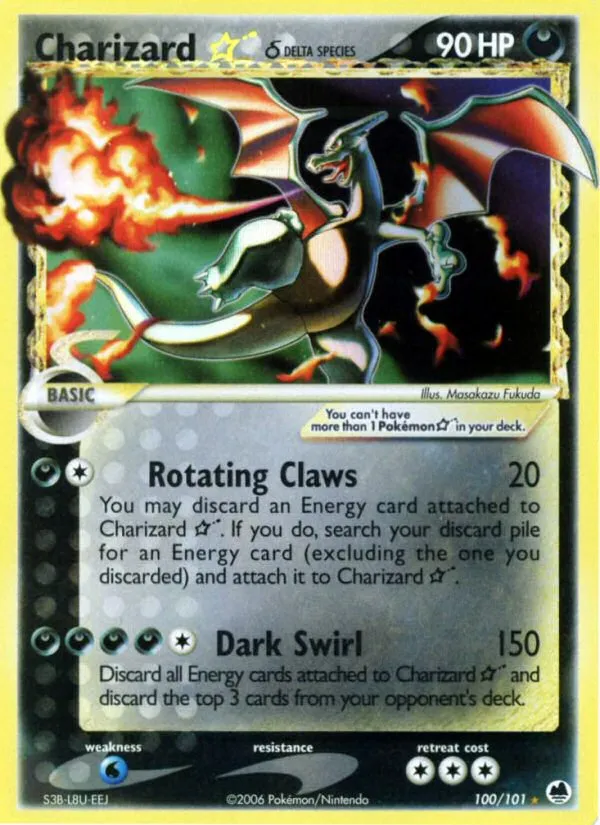
| Top EV contributor | Charizard ★ δ ($4000.00) |
| Gold Star slot rate | 1 in 17 |
| Pokémon-ex slot rate | 21.7% |
| Rare Holo slot rate | 28.0% |
| Rare slot rate | 44.5% |
| Price source | TCGPlayer market (live) |
Dragon Frontiers EV methodology
| Formula | Sum every slot contribution: rare-tier probability × average priced card value, plus fixed common/uncommon/energy slot count × average priced card value. |
|---|---|
| Assumptions | Uniform card selection within each rarity tier; raw ungraded USD market values; no grading premium, condition spread, sealed appreciation, or first-edition split. |
| Data source | Card pools from the bundled Pokemon TCG API catalog; prices from the bundled TCGplayer market snapshot; slot probabilities from the simulator pull-rate model. |
| Update cadence | Regenerated by prerender; price values update when npm run build:prices or the full data pipeline refreshes the snapshot. |
| Limitations | EV is a long-run mean, not the median pack result; one pack can land far below or above this number. |
Expected value (EV) is the average payout you'd get per booster pack if you opened thousands of Dragon Frontiers packs and summed the resulting card values at current market prices. It's the single most useful number for deciding whether a sealed product is worth opening vs holding.
Per-pack EV: $253.33
This is high-EV territory. The number is calculated from the live TCGPlayer market price snapshot in PackRip's catalog (refreshed every build via build-prices.mjs) multiplied by the per-card pull rate published in the simulator's rate table. EV does not account for grading premiums, sealed product appreciation, or first-edition variants — it's the raw "rip and sell" expectation for unlimited / non-graded copies.
EV breakdown by rarity slot
A Dragon Frontiers pack contains 9 cards: 1 rare slot, 3 uncommons, 3 commons, and 1 energy. Each slot contributes to total EV:
| Slot | Per-pack rate | Pool | Avg price | EV contribution |
|---|---|---|---|---|
| Gold Star | 5.80% | 2 cards | $3100.00 | $179.800 |
| Pokémon-ex | 21.70% | 10 cards | $187.68 | $40.725 |
| Rare Holo | 28.00% | 12 cards | $69.99 | $19.597 |
| Rare | 44.50% | 13 cards | $2.75 | $1.222 |
| Uncommon | 3 per pack | 28 cards | $2.15 | $6.463 |
| Common | 3 per pack | 30 cards | $1.27 | $3.821 |
| Energy | 1 per pack | 6 cards | $1.70 | $1.697 |
Top 8 cards driving the EV
These are the cards contributing the most expected value to a single Dragon Frontiers pack — the chase pulls that, weighted by how often they actually appear, do the most work in keeping the EV up:
- #1. Charizard ★ δ (Gold Star, $4000.00) — adds $116.000 to per-pack EV
- #2. Mew ★ δ (Gold Star, $2200.00) — adds $63.800 to per-pack EV
- #3. Rayquaza ex δ (Pokémon-ex, $330.00) — adds $7.161 to per-pack EV
- #4. Latios ex δ (Pokémon-ex, $329.98) — adds $7.161 to per-pack EV
- #5. Snorlax δ (Rare Holo, $197.83) — adds $4.616 to per-pack EV
- #6. Salamence ex δ (Pokémon-ex, $205.00) — adds $4.449 to per-pack EV
- #7. Dragonite ex δ (Pokémon-ex, $199.00) — adds $4.318 to per-pack EV
- #8. Ninetales δ (Rare Holo, $171.91) — adds $4.011 to per-pack EV
Variance is everything
EV is the long-run average. A single Dragon Frontiers pack will almost always be below EV — the median pack pulls one rare and four bulk commons. The high-end pulls (Crystal, Shining, Pokémon-ex) drag the average up because they're rare and valuable. If you open a single sealed booster expecting the EV, you'll be disappointed; if you open a sealed box (36 packs), the law of large numbers makes the actual return cluster much closer to the EV.
Open this set free on PackRip
Try Dragon Frontiers packs in the simulator with the same published pull rates this EV calculation uses. Coin economy is virtual — open as many as you want, then check your collection value on the Dragon Frontiers collection tracker to see how your simulated rips compare to the EV.
Singles or sealed — what the EV actually says
The comparison this page exists to support is a division, not a recommendation: a sealed Dragon Frontiers pack returns $253.33 on average, so ripping toward one specific card costs roughly that much per attempt plus the variance below. For Charizard ★ δ, the set's top EV contributor at $4000.00 market, that is about 16 packs' worth of expected value — buy the single below that and you are ahead, above it and the rip is the better trade on paper. PackRip sells nothing and earns no commission on any purchase you make, so this figure is not steering you anywhere: check current asks wherever you normally buy, and note that the prices here are a build-time snapshot from the Pokemon TCG API's TCGplayer mirror, not a live quote.
EV math walkthrough — in plain English
The arithmetic on this page is simpler than it looks. A Dragon Frontiers pack has 9 cards in fixed slots: 1 rare-slot card (which itself rolls across 4 sub-tiers — Holo Rare, Pokémon-ex, Gold Star, etc.), 3 uncommons, 3 commons, 1 energy. For each slot, you take the probability of pulling each card in the pool, multiply by that card's TCGPlayer market price, and sum. The rare-slot contribution dominates because the chase cards are 10-100× the price of a bulk common — even at 1-in-30 odds, a $4000 chase card contributes more per pack than 6 bulk commons combined. Dragon Frontiers's total EV of $253.33 is the sum of those slot contributions. If you opened 1,000 packs and sold every card at TCGPlayer market, you would expect to receive approximately $253326 — give or take the standard-deviation noise of the chase pulls.
EV is theoretical — single packs almost always disappoint
The single most important caveat about EV: it is the long-run mean, not the median single-pack result. The median Dragon Frontiers pack pulls one rare and four bulk commons and is worth $1-3 (well below the $253.33 headline number). The upside lives in the chase pulls, which are rare by definition. The distribution of pack values is heavily right-skewed: most packs are below EV, a small fraction of packs are massively above EV, and the average across thousands of packs eventually converges to the headline number. This is the same statistical structure as lottery tickets, slot machines, and any other pull-based randomization — the math is honest, but human intuition is calibrated to medians, not means, so the "expected value" rarely matches the felt experience of opening one pack at a time. If you open a sealed booster box (36 packs), the law of large numbers kicks in and your actual return clusters much closer to 36 × $253.33 = $9120.
EV vs sealed pack market price — is Dragon Frontiers worth ripping?
The buy-vs-rip question comes down to one comparison: the expected value above ($253.33) against whatever a sealed Dragon Frontiers pack actually costs today. PackRip does not track the sealed market, so check a live listing before treating this as a decision. For reference, Dragon Frontiers at $253.33 EV: the chase upside is large enough that ripping is usually the higher-EV play at typical sealed prices — with all the variance caveats.
Why pulling beats buying when EV is way above pack price
The case for ripping Dragon Frontiers packs hinges on a wider EV-to-sealed-price spread. When EV is 2× or more above the sealed pack price, you can rationalize ripping for three reasons: (1) the chase upside is asymmetric — most packs are below EV but the right-tail chases (Charizard ★ δ at $4000.00, contributing $116.000 per pack to EV all by itself) can return many times the pack cost in a single pull; (2) the cards themselves are usable in the simulator collection and PSA-gradable for further upside; (3) the experience itself has value (the pack-rip dopamine is what built the entire collecting hobby). The case against ripping when EV is below pack price is purely financial — you're paying $X for a $X EV outcome but eating all the variance, which is a strictly dominated trade vs buying the chases directly on TCGplayer. PackRip lets you simulate the rip for free either way, so the decision is risk-free at the consumer level — only your real-world wallet is on the line.