Most Valuable Rising Rivals Cards — Top 25 (Market Value)
| Set | Rising Rivals (pl2) |
|---|---|
| Year | 2009 |
| Total cards (priced) | 120 |
| Top card | Snorlax LV.X #111 — $600.00 |
| Top 25 combined value | $3470 |
| Price source | TCGPlayer market (live) |
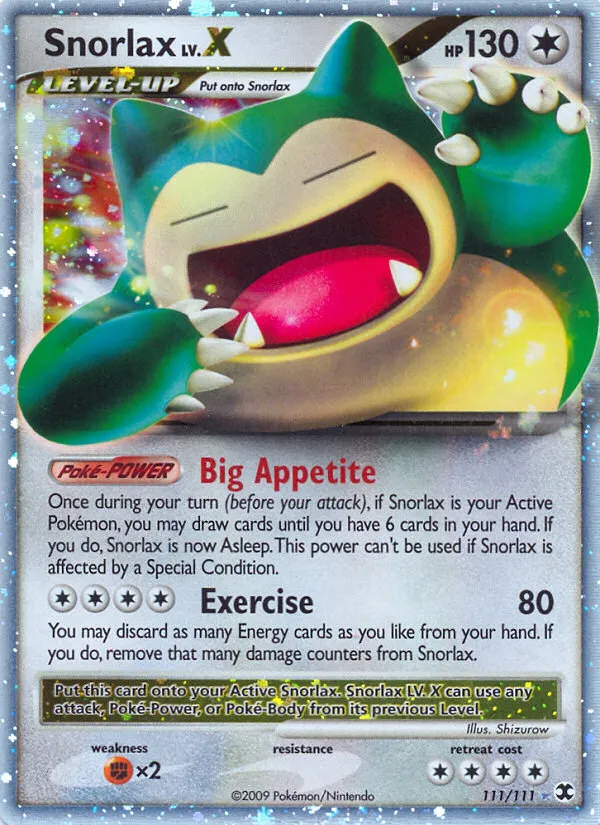
This is the live market-value ranking of every chase card in Rising Rivals (2009), the 120-card Pokémon TCG expansion. Prices update on each PackRip build from TCGPlayer's market feed, so these numbers track the actual ungraded market rather than retail asks. The top 25 alone account for roughly $3470 in combined market value — that's where the pack-opening EV comes from.
Top 25 by TCGPlayer market price
- #1. Snorlax LV.X — Lv.X, #111 — $600.00 (1 in 105 per pack)
- #2. Surfing Pikachu — Secret Rare, #114 — $388.58 (1 in 60 per pack)
- #3. Infernape E4 LV.X — Lv.X, #108 — $350.00 (1 in 105 per pack)
- #4. Alakazam E4 LV.X — Lv.X, #103 — $336.25 (1 in 105 per pack)
- #5. Pikachu — Secret Rare, #112 — $328.45 (1 in 60 per pack)
- #6. Flying Pikachu — Secret Rare, #113 — $208.03 (1 in 60 per pack)
- #7. Flygon LV.X — Lv.X, #105 — $122.61 (1 in 105 per pack)
- #8. Luxray GL LV.X — Lv.X, #109 — $120.58 (1 in 105 per pack)
- #9. Gallade E4 LV.X — Lv.X, #106 — $116.35 (1 in 105 per pack)
- #10. Floatzel GL LV.X — Lv.X, #104 — $100.00 (1 in 105 per pack)
- #11. Mismagius GL LV.X — Lv.X, #110 — $99.99 (1 in 105 per pack)
- #12. Heat Rotom — Rare, #RT3 — $95.07 (1 in 51 per pack)
- #13. Darkrai G — Rare Holo, #3 — $88.00 (1 in 46 per pack)
- #14. Hippowdon LV.X — Lv.X, #107 — $80.76 (1 in 105 per pack)
- #15. Arcanine — Rare Holo, #1 — $59.38 (1 in 46 per pack)
- #16. Jirachi — Rare Holo, #7 — $58.25 (1 in 46 per pack)
- #17. Wash Rotom — Rare, #RT5 — $50.89 (1 in 51 per pack)
- #18. Mow Rotom — Rare, #RT4 — $46.99 (1 in 51 per pack)
- #19. Frost Rotom — Rare, #RT2 — $45.32 (1 in 51 per pack)
- #20. Fan Rotom — Rare, #RT1 — $37.94 (1 in 51 per pack)
- #21. Gengar GL — Uncommon, #40 — $32.94 (10.7% per pack)
- #22. Snorlax — Rare, #33 — $29.98 (1 in 51 per pack)
- #23. Lucario GL — Rare Holo, #8 — $29.66 (1 in 46 per pack)
- #24. Flygon — Rare Holo, #5 — $22.99 (1 in 46 per pack)
- #25. Luxray GL — Rare Holo, #9 — $20.84 (1 in 46 per pack)
How to pull the top card
The single most valuable card in Rising Rivals is Snorlax LV.X at $600.00. You can chase it for free on PackRip's Rising Rivals pack opener — it uses PackRip's published per-rarity pull rates so the simulation produces the same expected-value distribution real boxes do over thousands of openings. The Hunt Pack mode boosts the relevant rarity slot if you want to optimize for this card specifically.
Why these prices change
2009 cards trade on relative supply: PSA pop reports, sealed-product scarcity, character popularity (especially Eeveelutions, starters, and legendary Pokémon), and grading-grade availability. PackRip refreshes its catalog every Phase release, so each new set drop pulls a fresh price snapshot via build-prices.mjs and the rankings reshuffle automatically. Bookmark this page — it stays current.
Why card #1 is worth multiples of card #25
The variance inside a single set's top-25 is itself the most informative number on this page. Snorlax LV.X at $600.00 sits roughly 28.8× the value of the #25 card ($20.84) — and that spread is the rule, not the exception, for 2009 Rising Rivals. The driver is a compounding stack: rarity tier (a Holo Rare is a 1-in-3 pull, a Crystal / Gold Star / Lv.X / Prime / Full Art chase is 1-in-30+), character popularity (Charizard / Pikachu / Eeveelutions trade at multi-x the average for the same rarity tier), illustration quality (full-art and alt-art prints command premiums regardless of competitive viability), and PSA pop-report scarcity (PSA-10 populations for 2009 cards are still expanding, so a low pop today can be 10× the future pop in two years). The top-25 sorts by the joint product of all four, which is why the curve is so steep at the top and flattens by #20+ where the cards are usually Holo Rares of less-popular Pokémon.
Raw vs graded — the multiplier nobody tells beginners
Every price on this page is the raw ungraded NM/M TCGplayer market price from PackRip's latest snapshot. Graded copies trade higher, but how much higher depends on the assigned grade and on that card's graded population — neither of which PackRip holds any data for, so no graded estimate is published here. PSA's population report and live sold listings are the right sources for that.
Historical price trend — how the Rising Rivals chase market evolved
Set-specific drivers — why Rising Rivals's top-25 looks the way it does
Condition grading deep-dive — the PSA 10 multiplier
The single biggest determinant of price for any vintage Pokémon card is grading status. PSA 10 ("Gem Mint") copies for 2009 Rising Rivals cards trade at substantial multiples of raw NM/M. The exact multiple depends on the specific card's pop report — common cards with high PSA 10 populations carry small premiums (1.5-2.5×), while chase cards with low PSA 10 populations carry massive premiums (8-15× or more). The threshold question for grading is whether the raw card is worth roughly 4× the grading fee — for Snorlax LV.X at $600.00 raw, grading economics work cleanly. PSA / BGS / CGC are the three main graders; PSA carries the highest market premium for vintage Pokémon, BGS for modern, CGC for anything in between. The grading turnaround time at PSA fluctuates between 30 days (premium service) and 12+ months (bulk service); the bulk service is rarely worth using because the grading fee is small relative to the holding cost of card capital tied up for a year.