How Many Packs to Pull Mew V from Darkness Ablaze
| Card | Mew V — Darkness Ablaze #69 |
|---|---|
| Rarity tier | Pokémon V |
| Per-pack odds | 1 in 84 |
| Expected packs to pull | 84 |
| 50% confidence band | 58 packs |
| 95% confidence band | 250 packs |
| TCGplayer market | $9.07 |
| Pack-rip break-even | 2 packs @ $5 |
Mew V chase methodology
| Formula | Specific-card odds = Pokémon V tier rate (16.70%) ÷ 14 cards; confidence bands solve 1 - (1 - p)^N. |
|---|---|
| Assumptions | Independent pack rolls, uniform selection within the rarity tier, no pity timers, no box mapping, no first-edition/condition split, no duplicate protection. |
| Data source | Card identity and rarity from the bundled Pokemon TCG API catalog; pull-rate constants from the live simulator; market price from the bundled TCGplayer snapshot. |
| Update cadence | Regenerated by prerender; price values update when the TCGplayer snapshot is refreshed through the data pipeline. |
| Limitations | The page estimates probability and raw market cost only; it does not model grading premiums, counterfeit risk, sealed-product appreciation, or individual print-run collation. |
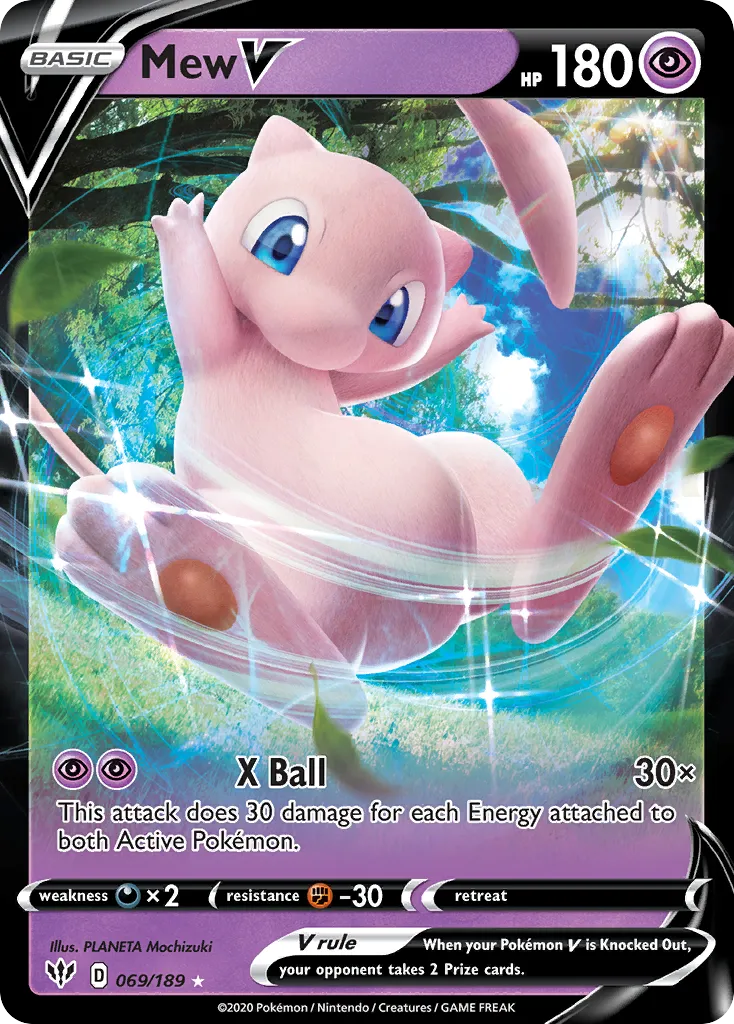
This page answers exactly one question: how many Darkness Ablaze booster packs does it take to pull Mew V #69? The numbers below come from the same per-rarity pull-rate model the PackRip Darkness Ablaze simulator runs on, mirrored from packGenerator.ts. TCGplayer pricing refreshes every build, so the buy-vs-rip verdict at the bottom reflects current market.
The math: ~1 in 84 per pack
Mew V sits in the Pokémon V rare-slot pool for Darkness Ablaze. There are 14 Pokémon V cards in the Darkness Ablaze pool, and the Pokémon V slot fires with probability 16.70% per pack. Since the slot is split evenly across the 14 cards in that tier, the per-pack chance of pulling this specific card is 1 in 84 — approximately 1 in 84.
Pulls are independent and identically distributed, so the number of packs until you hit Mew V follows a geometric distribution with parameter p = 0.011929. The expected number of packs is 1/p — that's ~84 packs on average. But "average" hides huge variance: the median pull lands faster than the mean (~58 packs at 50% confidence), and a long unlucky tail can stretch the wait dramatically. The 95% confidence band — 250 packs — is where 95% of pull-runs finish; the remaining 5% take even longer.
Concretely: if 100 collectors each opened Darkness Ablaze packs until they pulled Mew V, roughly 50 of them would have it by pack 58, 95 of them would have it by pack 250, and a handful would still be chasing past that. Expected ≠ guaranteed; the geometric distribution is famously long-tailed on the right side.
Confidence bands — packs vs cumulative probability
| P(pulled by N packs) | Packs needed | Sealed cost at $5/pack |
|---|---|---|
| 10% | 9 packs | ~$45 sealed cost |
| 25% | 24 packs | ~$120 sealed cost |
| 50% | 58 packs | ~$290 sealed cost |
| 75% | 116 packs | ~$580 sealed cost |
| 90% | 192 packs | ~$960 sealed cost |
| 95% | 250 packs | ~$1,250 sealed cost |
| 99% | 384 packs | ~$1,920 sealed cost |
Read this table as "what fraction of openers have pulled Mew V by pack N?". A 25% band of 24 packs means a quarter of openers hit it inside that window; 99% means almost everyone has hit it by pack 384. The dollar column anchors the variance to real-world sealed-pack cost at $5/pack.
Cheaper to buy Mew V as a single?
Buying Mew V as a single on TCGplayer (~$9.07) is dramatically cheaper than chasing it through packs — the expected pack-rip cost is roughly $419, well above the market price.
Pack-rip expected dollar cost for this specific card: ~$419 at $5 per Darkness Ablaze pack. Compare to $9.07 for the single on TCGplayer (Unlimited / non-graded copy at current market). The single buy obviously delivers exactly this card; the pack-rip approach delivers Mew V plus the remaining 9 cards in every pack along the way — which is why the EV calculator at /ev/swsh3 spreads the cost across the whole pack contents instead of pinning it to one card.
About Mew V (Darkness Ablaze)
Mew V is a Pokémon V card from Darkness Ablaze, the 2020 Pokémon TCG expansion. Darkness Ablaze (2020) runs 201 cards with Charizard V #19 and Charizard VMAX #20 near the front of the list rather than in a chase block at the back. Fourteen V and seven VMAX cards appear. Notably Charizard VMAX has no Rare Rainbow print here, though five other VMAX cards do. Colorless is the widest type at 26.
This specific card ranks as one of the top-3 most valuable pulls in Darkness Ablaze by TCGplayer market value, which is part of why the chase math is what it is — high market value tends to track with rarity-tier depth, since lower pool sizes concentrate value into fewer cards. The complete top-25 Darkness Ablaze ranking shows where Mew V sits relative to the rest of the chase pool.
Pull odds in context
For reference, a "1 in 84" pull is roughly comparable to a moderate chase — you should expect to crack a couple of boxes. The variance is the killer: any one pack could be the one. The simulation on PackRip's Darkness Ablaze opener uses the same exact RNG model, so you can stress-test the wait curve without spending real money.
Related chases
- Charizard VMAX — VMAX, $54.39 market
- Charizard V — Pokémon V, $10.46 market
- All Mew V printings across 3 sets
- All top-25 Darkness Ablaze chases
- Complete the Darkness Ablaze binder — full calculator
Open Darkness Ablaze free
Rip Darkness Ablaze packs free on PackRip's simulator with the same per-rarity pull rates this page is built from. The Hunt Pack mode boosts the Pokémon V slot if you specifically want to optimise for Mew V-tier pulls. Coin economy is virtual — no real money on the line.
Strategy: optimising the Mew V chase
Every experienced Darkness Ablaze hunter eventually picks one of three approaches for a specific chase card. The cheapest is the snipe: skip pack-ripping entirely, set a TCGplayer alert at or below the current $9.07 market, and wait for a motivated seller. This is the route most efficient-frontier collectors take when the chase is locked behind a deep rarity tier — and the math above shows why. The expected pack-rip cost ($419) is typically multiples of the single price, and the variance on that expectation is wide enough that a single bad streak can blow past the 95% confidence bound. The single buy is dollar-for-dollar cheaper and emotionally cheaper too — no more refreshing pack-pull videos at 3am.
The middle path is the box-rip-then-snipe: open a sealed booster box of Darkness Ablaze (typically 36 packs for vintage sets), enjoy the experience, then if you didn't hit Mew V in the box, buy the single for $9.07. A 36-pack box delivers a probability of 1 − (1 − p)36 ≈ 35.1% of pulling Mew V at least once, where p is the per-pack hit rate of 0.011929. So a sealed box gives you roughly a 35% chance of hitting this card "for free" alongside the rest of the box contents, plus the rip experience. If you miss, you backstop by buying the single — total worst-case cost is the box price plus the single. Most rational hobbyists end here.
The expensive path is pure-rip-to-pull: keep opening packs until Mew V appears. The expected total cost is ~$419, but the 95th percentile pushes that to ~$1,250. Almost nobody who does this comes out ahead financially — but it produces the binder story, the YouTube content, and the cumulative pulls of the entire pack contents along the way. If your real goal is collecting all of Darkness Ablaze, not just acquiring Mew V, the pure-rip path has an internal logic the singles path doesn't.
Variance is the entire story
Here's a concrete illustration of how wild the geometric distribution gets at low p. Consider 10 hypothetical openers all chasing Mew V from Darkness Ablaze. Mathematically, you'd expect their results to cluster near the 84-pack expectation — but they won't. Roughly 5 will pull Mew V within the first 58 packs and feel lucky. Roughly 3 will pull between 58 and 84 packs and feel "about average". And roughly 2 will be still pulling past pack 84, with one of them potentially stretching past the 95% bound of 250. The unlucky ones will swear the simulator is rigged, the rates are wrong, or that they have terrible RNG — but the math says exactly this distribution should happen every time. The geometric distribution has no memory: each pack is an independent draw, and a 100-pack dry streak does not increase the odds of the next pack hitting.
How Mew V compares to the broader Darkness Ablaze chase pool
Mew V sits in the Pokémon V tier of Darkness Ablaze's rare-slot pool. 14 cards share this tier, and the tier itself fires roughly 16.70% of the time per pack. That means the per-pack chance of pulling any Pokémon V card (not just Mew V) is 16.70%, which makes the expected wait for any Pokémon V card much shorter than the wait for this specific one. Pull-rate intuition: a single chase from a 6-card tier is 6× rarer than the tier itself. The deeper the pool, the longer the chase. This is also why "wide" sets with many chase cards in a single tier feel grindier per individual card despite the tier hit rate being identical — a thicker tier dilutes each card's specific share.
If your real goal is "any chase card from Darkness Ablaze" rather than "Mew V specifically", the math gets dramatically friendlier — the wait drops to ~6 packs on average for the tier as a whole. Most binder collectors approach it this way: chase the tier broadly across multiple sets, accept whatever pulls, and snipe the specific holes via TCGplayer later. Targeting one card from a thick tier is the most expensive way to play the chase, and Mew V is no exception.