Complete the Vivid Voltage Binder — Calculator
| Set | Vivid Voltage (swsh4) |
|---|---|
| Year | 2020 |
| Total cards | 203 |
| Bottleneck rarity | Rainbow Rare (12 cards) |
| Expected packs (~95%) | 1,330 packs |
| Pack-rip cost @ $5/pack | ~$6,650 |
| TCGplayer singles total | ~$518 |
| Cheapest route | Singles |
Vivid Voltage binder-completion methodology
| Formula | For each rarity slot, expected packs = (pool size × harmonic(pool size)) ÷ per-pack slot rate; the slowest slot is the binder bottleneck. |
|---|---|
| Assumptions | Independent pack rolls, uniform card selection inside each rarity tier, one needed copy per checklist card, no trading, no Pack Dust crafting, no short-print adjustment. |
| Data source | Checklist and rarity pools from the bundled Pokemon TCG API catalog; slot rates from the simulator pull-rate model; singles total from priced TCGplayer market rows. |
| Update cadence | Regenerated by prerender; price values update when the TCGplayer snapshot is refreshed through the data pipeline. |
| Limitations | Coupon-collector math estimates the pack grind, not condition quality, sealed-box collation, real dealer availability, or the value of duplicate cards. |
Completing the Vivid Voltage binder means owning one copy of every card in the 203-card checklist. The math below tells you how many sealed booster packs it actually takes (worst case: the rarest tier), how that compares to buying every single on TCGplayer at current market prices, and which slots cause the long-tail grind. Numbers refresh on every PackRip build because the price snapshot and pool sizes are pulled live from the same catalog the simulator runs on.
How the math works
This is the classic coupon collector problem. For a uniform random draw across N distinct cards, the expected number of draws to see every card at least once is E[T] = N · HN, where HN is the N-th harmonic number (1 + 1/2 + 1/3 + … + 1/N). The closer you get to "all N", the more the cost of each additional unique card explodes — the very last card alone takes on average N more draws once you have N − 1. That's why the curve is brutally non-linear and why the last few binder slots feel impossible.
Booster packs aren't single-card draws — they're 10-card draws with structured rarity slots. We treat each rarity slot as its own coupon-collector subproblem: the rare slot has its own pool and its own per-pack hit rate; the uncommon slot pulls 3 cards per pack from a different pool; the common slot pulls 4 per pack; the energy slot pulls 1. For each tier we compute (pool size × Hpool size) ÷ per-pack hit rate — the expected packs until that subset is complete. The longest subproblem is the binder bottleneck.
We also report a 95% confidence bound using the standard coupon-collector tail approximation T95 ≈ N · (ln N + ln 20). Roughly: if you opened T95 packs, you'd finish the binder in about 95% of parallel-universe runs. The gap between expected and 95% bound is wide for rare tiers — small pool, slow tail — and tight for commons.
Per-rarity completion breakdown
Each row is one slot/tier in the Vivid Voltage pack structure. The "expected" column is the answer to "how many packs to finish this tier alone"; the "95%" column is the worst-case grind. The bottleneck — biggest expected number — is what governs binder completion overall.
| Tier | Pool size | Per-pack rate | Expected packs | 95% confidence |
|---|---|---|---|---|
| Rainbow Rare | 12 cards | 2.80% per pack | 1,330 | 2,349 |
| Full Art | 20 cards | 8.56% per pack | 841 | 1,400 |
| Rare | 33 cards | 27.82% per pack | 486 | 771 |
| Secret Rare | 6 cards | 5.00% per pack | 295 | 575 |
| VMAX | 6 cards | 5.56% per pack | 265 | 517 |
| Amazing Rare | 6 cards | 5.56% per pack | 265 | 517 |
| Rare Holo | 19 cards | 28.00% per pack | 241 | 404 |
| Pokémon V | 11 cards | 16.70% per pack | 199 | 356 |
| Uncommon | 42 cards | 3 per pack | 61 | 95 |
| Common | 44 cards | 4 per pack | 49 | 75 |
| Energy | 4 cards | 1 per pack | 9 | 18 |
Bottleneck for Vivid Voltage: Rainbow Rare at ~1,330 expected packs. Every other slot finishes inside that window, often dramatically faster (commons usually wrap in under 100 packs).
Why complete the Vivid Voltage binder
Vivid Voltage (2020) introduces the Amazing Rare tier to PackRip's catalog with exactly six cards — Celebi #9, Raikou #50, Zacian #82, Zamazenta #102, Jirachi #119 and Rayquaza #138 — which the engine draws from a 5.56 percent slice of the rare slot. Across its 203 cards the Rare Ultra tier is unusually deep at 20, and 21 Supporters appear. Seventy-five illustrators contributed.
For binder collectors the appeal of finishing Vivid Voltage is rarely about resale return — it's about closure. A complete binder of any vintage set is a visual time capsule: every Pokémon from that era's pool, every artist credit, every set symbol uniform under one cover. Most serious WotC and EX-era collectors keep at least one near-complete master binder per set, and the difference between "almost complete" and "complete" is what separates a casual collection from a curated one.
Investment angle: sealed sealed-product appreciation for 2020 releases has been steady-to-strong over the past five years, but loose-card completion behaves differently. Common and uncommon singles for vintage sets stay cheap forever because supply was massive; the binder grind is therefore mostly about the chase rarities, which is where the math above concentrates. If you're optimising for cost, the cheapest path is almost always "rip a few sealed packs for the experience, then close the binder with TCGplayer singles" — and that's a feature, not a bug.
Hunt the chase cards
The hardest cards in Vivid Voltage aren't randomly hard — they're the rarest tier. Here are the top chases driving the binder grind:
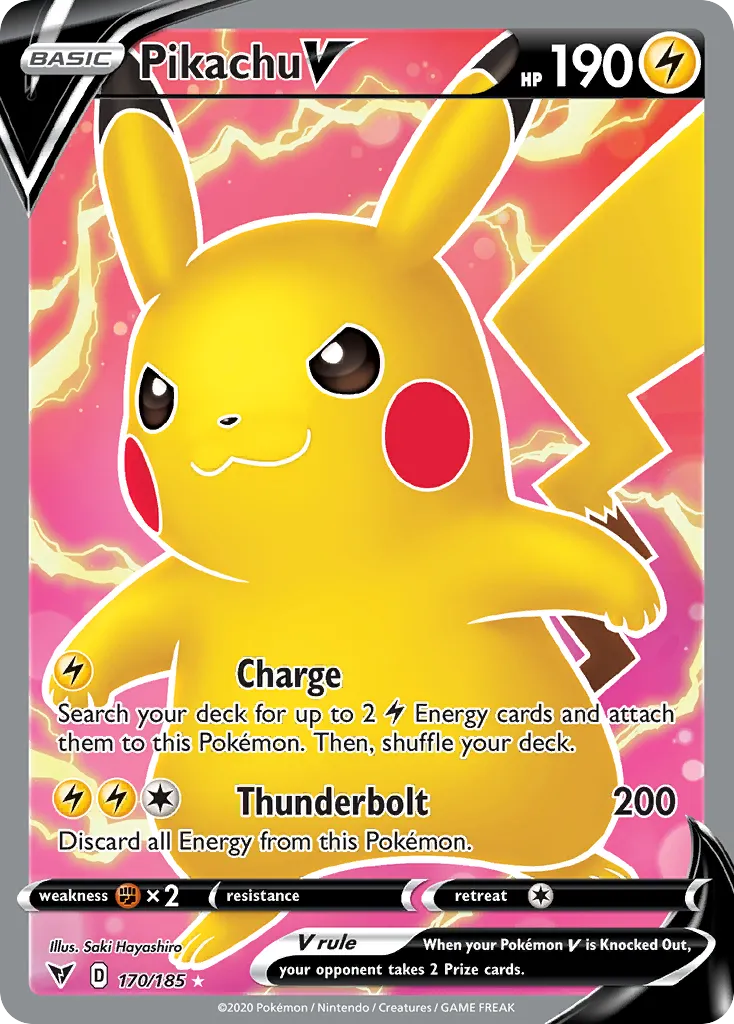
- #1 — Pikachu V (Full Art, #170) — $45.88 market
- #2 — Pokémon Center Lady (Full Art, #185) — $19.68 market
- #3 — Nessa (Full Art, #183) — $9.69 market
Each chase card has its own per-card landing page with pull odds, expected packs to pull just that one card, and a 50%/95% confidence band. Click any of the names above to drill into the single-card math.
Buy singles instead of ripping packs
Buying singles on TCGplayer (~$518) is dramatically cheaper than ripping packs (~$6,650). Use packs for the chase moments and singles to fill the holes.
Open this set free on PackRip
Want to simulate the binder grind without spending? PackRip's Vivid Voltage pack opener uses the exact same pull-rate math this page is built from. The Hunt Pack mode boosts the slot of your choice — useful if you want to pressure-test the bottleneck tier before committing real cash. Track binder progress on the Vivid Voltage collection screen as you rip.
Strategy: how serious collectors actually finish a vintage binder
Conversations with long-time WotC, EX-era, and DP-era collectors reveal a consistent pattern: nobody who finishes a binder does it by ripping packs only. The math above is exactly why. Even on the relatively short-tail sets, the bottleneck tier — Rainbow Rare for Vivid Voltage — produces a long tail of 95th-percentile outcomes that exceed any reasonable sealed-product budget. The winning strategy is layered. First, decide whether you want a "rip binder" (where ripping is the experience and the binder is a souvenir) or a "completion binder" (where the holy goal is closure). The two binders run on completely different budgets and different timelines.
For a completion binder, the dominant playbook is: target one to three sealed booster boxes of Vivid Voltage for the nostalgia rip, sleeve everything that comes out, then list the holes in a spreadsheet and price-snipe TCGplayer over a 3-12 month window. Most of the bottleneck-rarity holes get filled at-or-below market via patient watchlist alerts and TCGplayer's "Lowest Listing" filter; a handful might take a private deal or a forum trade. Bulk commons and uncommons fill themselves from any of three sources: dealer 5,000-card bulk lots ($25-50 typically clears 80% of an uncommon pool), trader friends offloading dupes, or supplementary single packs grabbed at hobby shops. The "pure pack-rip to completion" path is technically possible but financially irrational on every measurable axis — the math above shows Vivid Voltage specifically would require an expected ~$6,650 in sealed product just to reach the 95% completion threshold, before even accounting for the value of your time and the storage space for thousands of dupes.
For a rip binder, the math doesn't matter — what matters is how many packs you genuinely want to open. Pick a budget you're comfortable with (a sealed booster pack of vintage 2020 Vivid Voltage runs roughly $5 on the secondary market for raw, unweighed product; sealed boxes carry premiums depending on rarity and authentication). Open them. Whatever you pull is the binder. Use the simulator on PackRip first if you want to feel the variance without spending — a 36-pack box on PackRip will hit the same statistical distribution as a real one, just with virtual cards and zero risk of weighed packs or fakes in the secondary market.
What this calculator does not model
A few realistic factors are intentionally absent so the math stays cleanly interpretable. First, this calculator assumes uniform distribution within each rarity tier — real print runs over- or under-shorted specific cards, but per-set collation data is not public. Second, this is a single-pack-at-a-time calculation; buying a booster box does not change the expected number of packs, and the dollar comparison uses the standard $5/pack reference so the math stays comparable across sets. Third, condition and grading are not modelled — a binder of NM raw cards, a binder of graded cards and a binder of played copies are three different products, and PackRip holds no grading-cost or graded-price data. Fourth, sealed-product appreciation is not modelled either.